
Top 5 Lenders for Land Loans with Bad Credit in 2026
Last updated: 2026-11-25
Dreaming of owning a piece of dirt to call your own is a common goal, but a rocky credit history often stands in the way. If your score isn’t where it needs to be, securing a land loan can feel like swimming upstream against a heavy current. You aren’t alone in this struggle. Many potential landowners find themselves stuck in a loop of “denied” letters because traditional lenders view raw land as a high-risk asset compared to established residential properties.
The lenders listed here focus on different parts of the borrowing experience, ranging from speed to specialized community support. When choosing a partner for your land acquisition, think about how much cash you actually need and how fast you need it to hit your bank account. Every financial journey is unique, and the right tool depends on your specific destination. Are you looking for a long-term mortgage to build a home, or a short-term bridge to secure a parcel before a developer moves in? The answer dictates which lender you should prioritize.
- Addition Financial
- JetzLoan
- Credit Union West
- Parra Loan Company
- NetCredit
How These Land Financing Options Were Evaluated
Selecting the right lender involves looking past the glossy advertisements and diving into the actual mechanics of the loan process. It isn’t just about who says yes, but how they say yes. This ranking examines several key metrics, including the maximum amount available to borrowers and the speed at which funds can be distributed. We didn’t just look at interest rates, because in the world of non-traditional lending, the “cost” of a loan is often measured in time and accessibility rather than just a percentage point.
Speed is often the lifeblood of real estate deals, especially when a seller is eager to move on or when a property is listed as an auction item. We looked at how quickly different providers can move from an initial application to actual funding. We also prioritized lenders that offer transparency regarding credit checks, ensuring that looking for a loan doesn’t inadvertently damage a fragile credit score further. A “soft pull” for an initial quote is a luxury that many borrowers with low scores cannot afford to skip.
| Lender Name | Max Loan Amount | Funding Speed | Credit Impact |
|---|---|---|---|
| Addition Financial | See site | See site | See site |
| JetzLoan | $50,000 | As little as 24 hours | No hard credit pull |
| Credit Union West | See site | See site | See site |
| Parra Loan Company | $1,840 | Approved in minutes | See site |
| NetCredit | $10,000 | Same-day funding available* | Won’t affect FICO® score |
The Best Lenders for Land Financing with Challenging Credit
1. Addition Financial
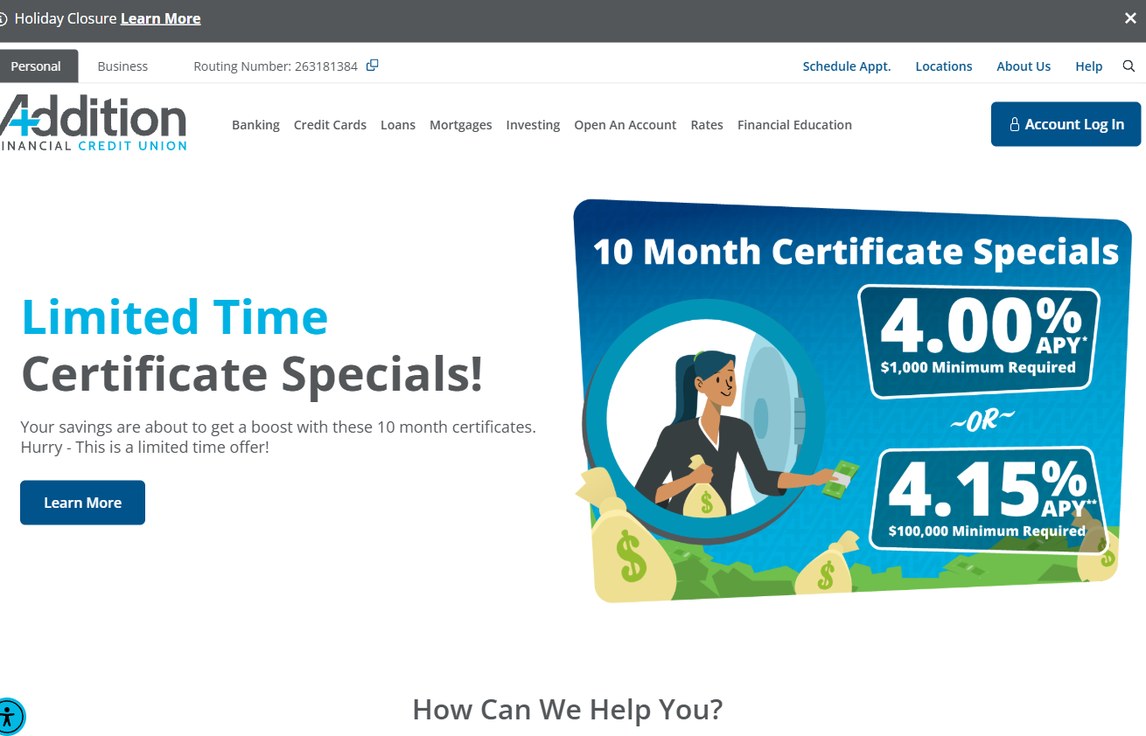
Addition Financial functions as a full-service credit union, offering a broad spectrum of personal banking and mortgage services. Because they operate as a member-owned institution, the focus often shifts toward long-term financial health rather than just quick, high-interest transactions. This can be a breath of fresh air for those looking to build something lasting. Unlike big-box banks that use rigid, automated algorithms to reject applications, credit unions often allow for a more nuanced review of your financial situation.
This lender is ideal for individuals who want a holistic banking relationship. Instead of just a one-off loan, you can manage your checking, savings, and future investments all under one roof. For example, if you plan to build a home on your land in two years, having your primary banking with the same institution that holds your land loan can sometimes streamline the transition to a construction mortgage. It is a solid choice for those who value community-oriented financial stability over the lightning-fast, high-cost alternatives found elsewhere.
Pros:
- Comprehensive range of financial products from mortgages to business loans.
- Member-focused service model common to credit unions.
- Offers various ways to grow wealth, including certificate specials.
Cons:
- Requires membership to access most services.
- May have more stringent requirements than specialized high-interest lenders.
2. JetzLoan
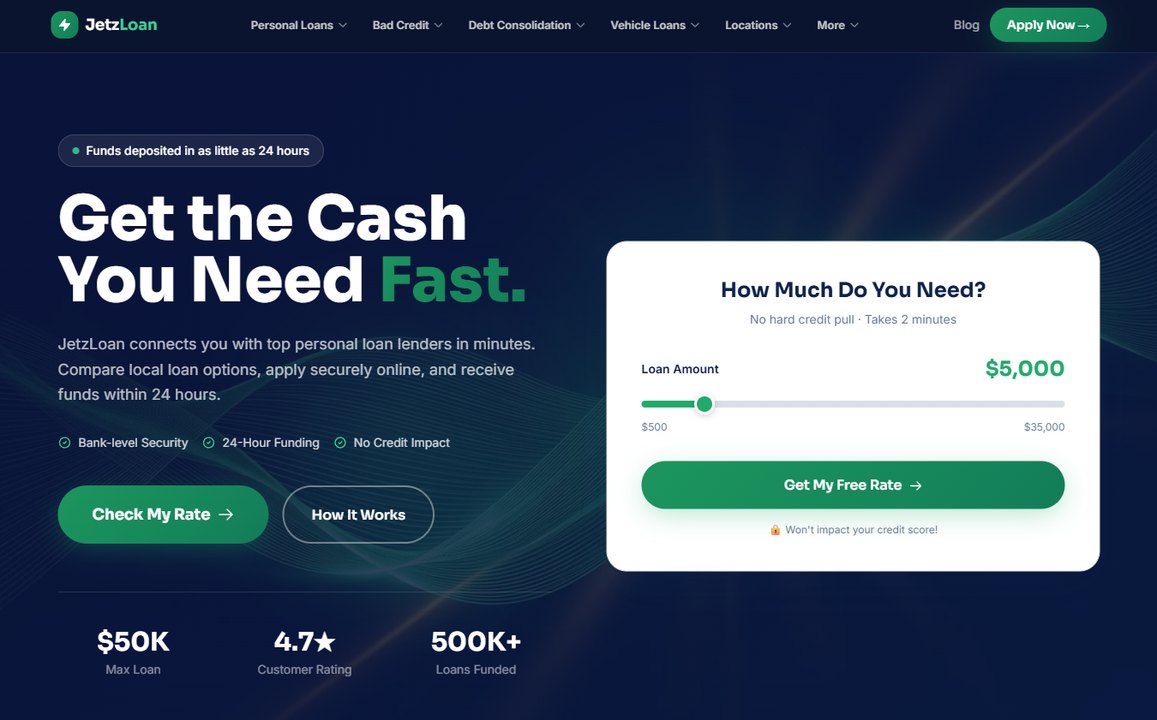
Sometimes, you need to move at the speed of light to secure a property before someone else grabs it. JetzLoan acts as a digital bridge, connecting borrowers with top personal loan lenders in a matter of minutes. It is designed for the modern borrower who values efficiency and digital-first interactions above all else. In a competitive real estate market, being able to provide proof of funds or a quick down payment can be the difference between winning a bid and losing a dream property.
The platform is particularly useful for those with imperfect credit who are terrified of the “hard pull” trap. Since they offer a way to check rates without impacting your score, you can shop around with confidence. This “pre-qualification” stage is vital; it allows you to see if you are even in the running for a $50,000 loan before you commit to a formal application that leaves a permanent mark on your credit report. If you can get approved, the money can be in your account in as little as 24 hours.
Pros:
- Extremely fast funding, potentially within 24 hours.
- No hard credit pull for checking your rates.
- High customer rating and significant volume of loans funded.
Cons:
- The platform acts as a connector rather than the direct lender in all cases.
- Loan amounts are capped at $50,000.
3. Credit Union West
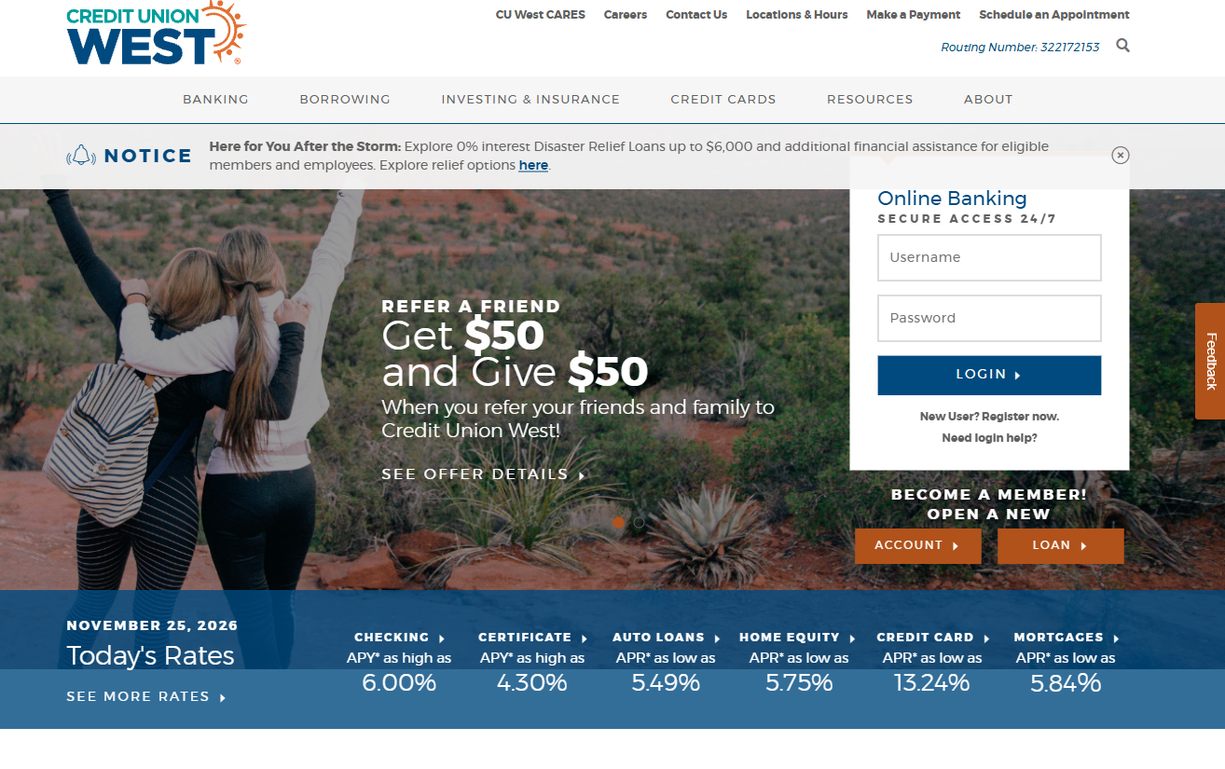
Credit Union West provides a localized touch for those who prefer a community-centric approach to their finances. They offer a variety of services ranging from basic checking to more complex borrowing needs. For members facing unexpected hardships, they have even demonstrated a commitment to community support through specialized relief programs. This level of empathy is often missing in the standardized, computerized responses of national mega-banks.
This institution is a strong candidate for those who want a lender that understands the local landscape. For example, if you are buying land in a region prone to environmental shifts, a lender that understands regional economic trends or offers disaster relief options provides a layer of security that a national lender simply cannot match. Their focus on member benefits, such as high-yield savings certificates and disaster relief options, suggests a lender that cares about the stability of its members. It is a reliable choice for those looking for stability.
Pros:
- Offers specialized assistance like disaster relief loans.
- High-yield savings options to help build wealth.
- Strong presence in the Arizona region.
Cons:
- Service is heavily localized, which may limit those outside their primary regions.
- Standard credit union membership requirements apply.
4. Parra Loan Company

Parra Loan Company specializes in small, quick-access signature loans that can help bridge a financial gap. These are not meant for purchasing a massive estate, but they are perfect for covering the smaller, immediate costs associated with land ownership. These costs can add up quickly: you might need $1,500 for a land survey to confirm boundaries, another $800 for a soil test to see if the ground is suitable for a septic system, or $1,200 for environmental permits. These are “pre-purchase” costs that traditional lenders often won’t cover.
The simplicity of their process is their biggest selling point. You can apply online, over the phone, or in person at a branch. With approval coming in minutes and no collateral required, it is a very flexible option for short-term needs that don’t require a massive mountain of paperwork. If you are just looking to cover the immediate “due diligence” costs before you commit to a long-term mortgage, this is a highly efficient tool.
Pros:
- Extremely fast approval process, often within minutes.
- No collateral required for their signature loans.
- Very easy application process through multiple channels.
Cons:
- Loan amounts are relatively low, topping out at $1,840.
- Primarily designed for short-term financial needs rather than large land purchases.
5. NetCredit
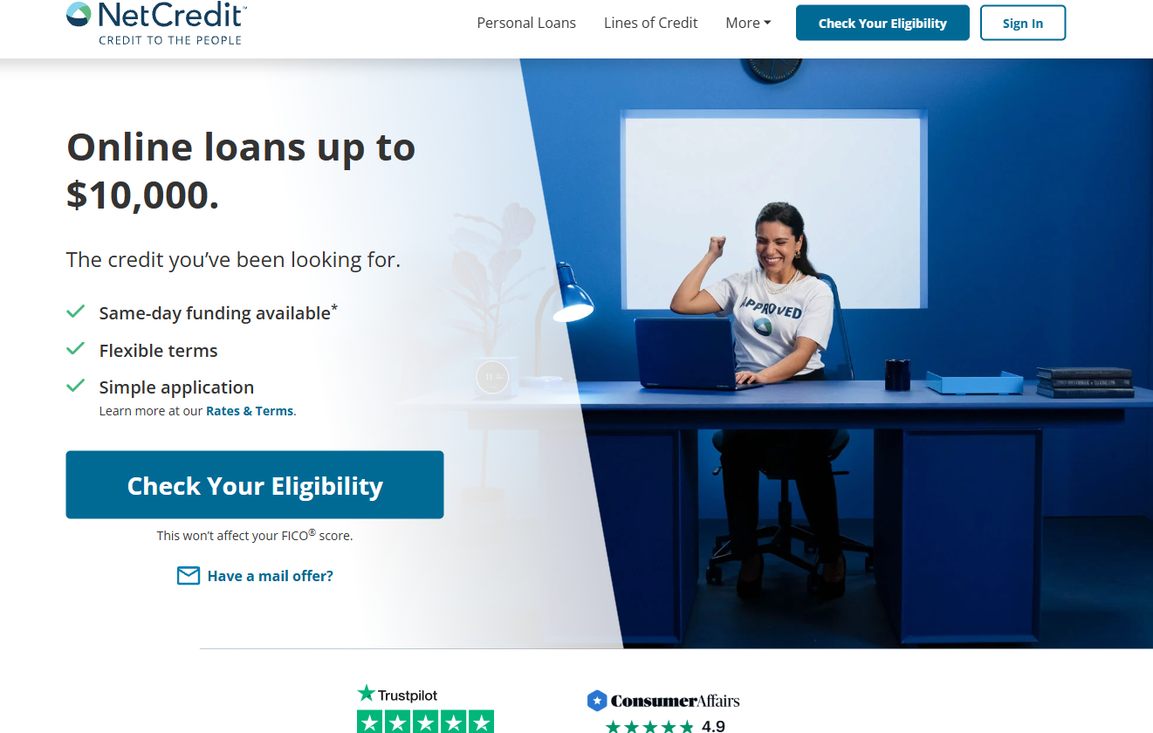
NetCredit takes a more human-centric approach to lending by acknowledging that a person is more than just a number in a database. Their algorithms look beyond the FICO score to find potential in borrowers who might be overlooked by traditional banks. They consider alternative data points, such as your history of consistent income or your utility payment patterns, which can be a lifesaver for someone with a recent dip in their credit score due to a medical emergency or job transition.
The company offers a streamlined online experience with the potential for same-day funding. With loan amounts reaching up to $10,000, it provides a middle ground between a small signature loan and a massive mortgage. It is a modern solution for people who want transparency and speed in their digital life. If you need to pay a deposit on a small plot of land to hold it while you wait for your main mortgage to be processed, NetCredit provides the necessary bridge.
Pros:
- Sophisticated underwriting that looks beyond just the credit score.
- Potential for same-day funding to meet urgent needs.
- Simple and flexible online application process.
Cons:
- Loan amounts are capped at $10,000, which may be low for land.
- Terms and rates are subject to underwriting and partner bank availability.
Understanding the Types of Land Loans Available
Before you apply, it is crucial to understand that “land loans” is a broad term that covers several distinct financial products. Not all land is treated equal by lenders, and knowing which category your project falls into can save you weeks of wasted time. Generally, land financing falls into one of three categories:
| Loan Type | Best For… | Typical Requirements |
|---|---|---|
Raw Land Loan |
Unimproved land with no utilities or road access. | Higher down payments (20-50%), higher interest rates. |
Unimproved/Semi-Improved |
Land with existing road access or basic utilities. | Moderate down payments; more standard interest rates. |
Residential Land Loan |
Land specifically zoned for a single-family home. | Easiest to secure; often treated like a standard mortgage. |
If you are looking at “raw land,” prepare for more scrutiny. Lenders want to know how you will access the property and how you will get water and sewage. If the land is completely isolated, the lender sees it as a high-risk asset because it’s harder to sell if you default. This is why many people find success using a personal loan (like those from JetzLoan or NetCredit) to fund the initial surveys and assessments required to turn “raw land” into “improved land,” which is much easier to finance through a traditional mortgage later.
Alternatively, if you are purchasing land that is already part of a subdivision with existing utility connections, you are in a much stronger position. These are often called “improved land” loans. Lenders are far more comfortable with these because the “value” of the land is more predictable. Understanding this distinction allows you to approach the right lender with the right expectations. Don’t go to a high-speed personal loan lender for a $200,000 plot of forest; go to a credit union for that. Use the fast, small-scale lenders to facilitate the steps that make the big loans possible.
Navigating the Path to Your Property
Choosing a lender is a bit like picking a vehicle for a long cross-country trip. You need to know if you need a heavy-duty truck for the rough terrain or a quick motorcycle to zip through city traffic. If you are looking for a massive mortgage to buy an acre of forest, a credit union might be your best bet. If you just need to pay a deposit tomorrow, a digital connector might be the way to go.
One of the most common mistakes people make is neglecting the fine print. Always ask about the total cost of borrowing, not just the monthly payment. High-speed, low-requirement loans often come with higher interest rates, which can become a heavy weight on your shoulders in the long run. Always weigh the speed of the cash against the cost of the debt. A loan that is “easy” to get can become very “hard” to pay back if the APR is significantly higher than the market average.
Another pitfall is failing to verify the specific requirements for land-only loans. Some lenders are comfortable with residential mortgages but hesitate when the collateral is just a plot of dirt. Always be upfront about your intent to use the funds for land. Honesty from the start prevents heartbreak at the closing table and keeps your financial reputation intact. If you tell a lender you are buying a home and then use the funds for a vacant lot, you could be flagged for mortgage fraud. Be clear, be prepared, and choose the tool that fits your specific soil.